
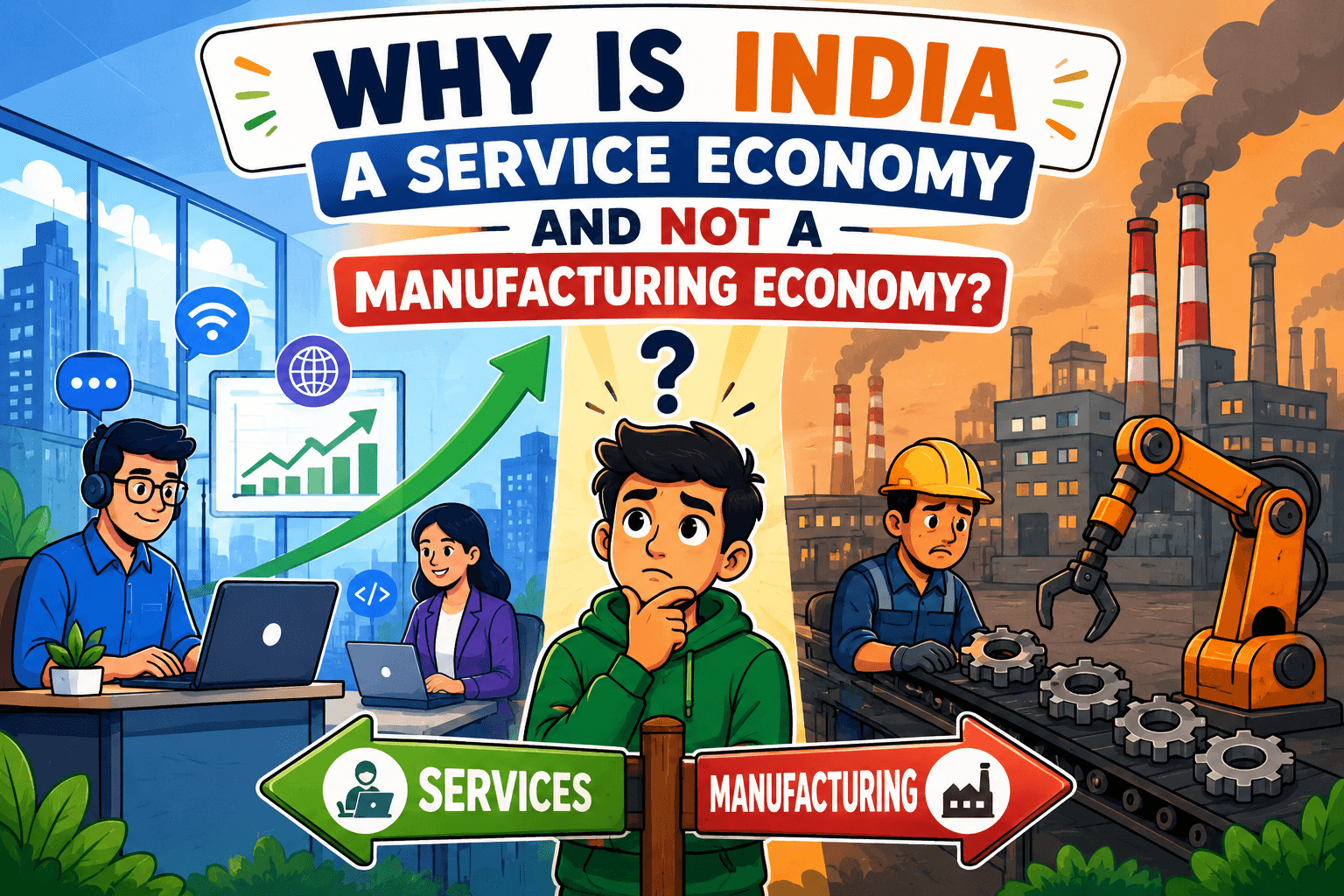
Why is India a Service Economy and Not a Manufacturing Economy?
India is a unique country, extremely different from other developing nations and poles apart from Western Countries, in its socio-cultural setup, political environment and economic development. After Independence in 1947, India became the largest democracy in the world. While Indian National Congress was initially the major political party, but, eventually multiple political parties bloomed. Socially, India has always thrived in the idea of “unity in Diversity”, be it linguistically or in terms of religions being followed or fashion, architecture, social customs or history. In terms of Economics, India started out as an Agricultural Economy but its Growth trajectory skipped the Manufacturing sector and its Service Sector saw a tenfold growth. India never saw an Industrial Revolution after its Agricultural Revolution, which started after 1965. This is a major difference between the development of the Indian Economy and Chinese Economy.
Development of the manufacturing sector in India was given focus in the Second Five Year Plan under what is popularly known as the Mahalanobis Model, a Marxist-inspired economic development strategy that prioritizes investment in heavy capital goods (like steel and machinery) over consumer goods to build long-term economic capacity. The Political leader at that point correctly thought that India should build heavy steel and machinery industries which would help in building dams, which would in turn generate electricity and help factories and manufacturing units flourish. However, the steps taken to develop the Manufacturing sector did not lead to the expected results. Instead, India saw what may be termed as Premature Deindustrialization. Premature deindustrialization in India refers to the decline of the industrial sector in the country before it reached its full potential. At present the share of Manufacturing Sector to India’s GDP is 17% compared to Share of Services Sector to India's GDP at 55%. At the workforce front, the share of Manufacturing Sector to India’s workforce is 15% compared to the share of Services Sector to India's workforce at 30%.
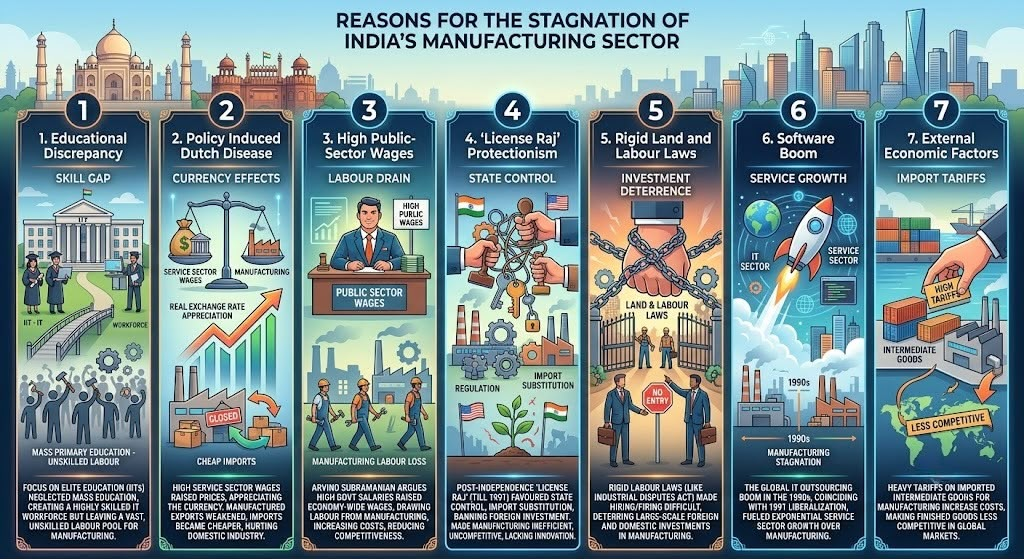 The reasons for the stagnation of Manufacturing sector are as follows:
1. Educational discrepancy: In order to build Dams and give a thrust to Manufacturing Industries, the Government Of India set up IITs to produce expert level engineers. It ignored mass primary education. While this created a highly skilled, English-proficient workforce perfect for the IT and software boom, it left a massive unskilled labor pool unable to meet the demands of the complex, labor-intensive manufacturing sector.
2. Policy Induced Dutch Disease: The Dutch Disease refers to the phenomenon where an economic windfall can often translate into negative outcomes in the other sectors, such as manufacturing. It was initially coined to explain how the discovery of the Groningen gas fields in 1959 affected Dutch manufacturing. The theory goes as follows: imagine an economy where a substantial holding of some natural resource — such as oil or another important mineral — is discovered. This would lead to a rise in wages as the sector bids away labor from other sectors, raising the economy-wide wage rate. Moreover, exports of the resource would lead to an appreciation of the currency, increasing imports and decreasing other price-sensitive exports. These effects would hurt domestic manufacturing, which would be outcompeted by cheap imports from abroad and, at the same time, become relatively expensive in foreign markets.
In India, higher wages in the Service sector raised domestic prices, causing real exchange rate appreciation. Manufactured exports weakened, imports became cheaper, hurting the domestic manufacturing industry.
3. High public-sector wages: Arvind Subramanian argues that high government salaries raised economy-wide wages, drawing labor away from manufacturing. This increased costs and reduced manufacturing competitiveness.
4. ‘License Raj’ in name of Protectionism: Post-independence policies till 1991, commonly known as the License Raj, favored import substitution and heavy state control over private enterprise. Foreign investment was not allowed. This made the manufacturing sector heavily regulated, inefficient, and largely uncompetitive in the global market. This resulted in lack of innovation and productivity.
5. Rigid Land and Labor Laws: Rigid labor laws (like the Industrial Disputes Act) made hiring and firing difficult, deterring large-scale foreign and domestic investments in manufacturing operations.
6. Software Boom: In 1990, the IT sector boomed, with the global markets outsourcing software development and IT back-office operations to India. Around that time, India also Liberalized, Privatized and Globalized the Indian Economy in 1991, resulting in exponential growth of the Service Sector.
7. External Economic Factors: Import of intermediate goods in Manufacturing industries incurs heavy tariffs. High tariffs on intermediate goods increase costs, rendering these goods less competitive in global markets.
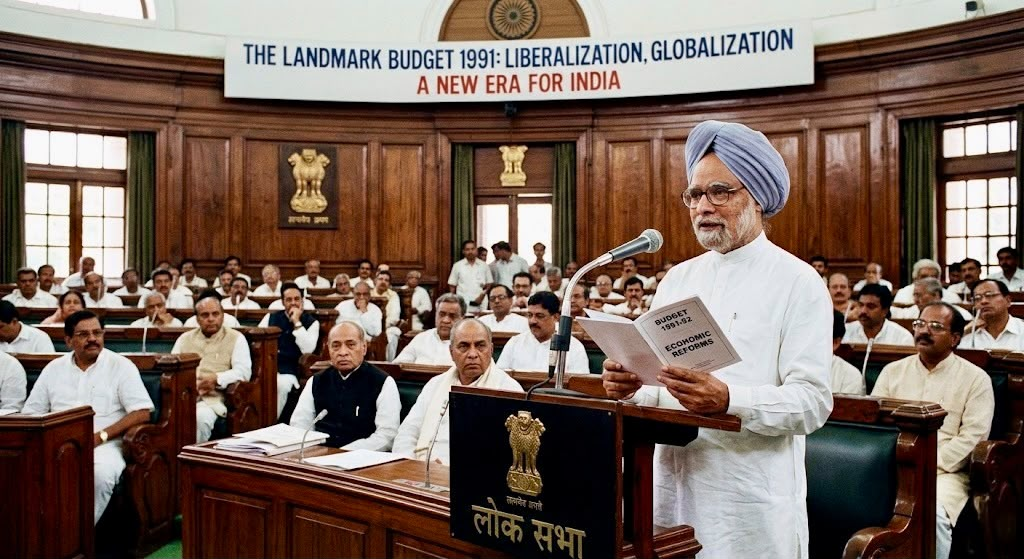 In 1991, the Indian economy faced a massive turmoil. There was a severe Balance of Payment deficit, high inflation, fiscal mismanagement, and global pressure for structural economic reforms. To avoid sovereign default, India pledged 67 tons of gold as collateral for emergency loans, signaling the severity of the crisis and the urgent need for structural reforms. These reforms known as the LPG reforms formed a major chunk of the New Economic Policy of 1991, rolled out by then Prime Minister Shri PV Narsimha Rao and Finance Minister Dr Manmohan Singh. Key components of the policy included liberalization, privatization, and globalization, collectively known as the LPG model. These reforms dismantled the 'License Raj,' reduced the public sector's dominance, and opened avenues for foreign investment, laying the foundation for India's rapid economic growth in the subsequent decades. However, the Service Sector saw exponential growth while the Manufacturing sector stagnated. Key drivers of this explosive expansion are as follows:
1. LPG Reforms- The LPG Reforms coincided with the software/IT sector boom. Global markets outsourced the back office operations to India.
2. Demographic advantage and available skilled talent pool- India’s workforce, being proficient in English language made it highly demanded in global markets .
3. Social Shifts: Changing family structures and an increase in working women have spurred the growth of support services like domestic help agencies, childcare, and food delivery platforms.
4. Government policies: The Indian government has implemented several policies to support the growth of the service sector, including tax breaks, subsidies, and investment in infrastructure.
As a result of exponential growth of the Service Sector, the potential of the Manufacturing Sector still remains untapped. With the saturation of the Service Sector, the need of the hour is to develop the Manufacturing sector since it offers immense potential to generate employment, boost productivity, strengthen exports, and reduce import dependence. As a fallout of global turmoil viz Russian Ukraine War, Iran- US War, the Government of India has taken the following initiatives to boost the Manufacturing Sector and be less dependent on imports.
1. Make in India: Launched in 2014, aims to raise manufacturing’s share in GDP from 17% to 25%, focusing on electronics, automotive, defense, and textiles.
2. National Manufacturing Mission (NMM): Launched in Union Budget 2025–26, NMM integrates policy, execution, and governance across ministries and states. Focuses on sustainable manufacturing, promoting solar PV modules, EV batteries, green hydrogen, and wind turbines.
3. GST Reforms: GST 2.0 introduces a two-slab system, reducing compliance costs and provides a simplified structure.
4. Production Linked Incentive (PLI) Scheme: Launched in 2020, covering 14 key sectors including mobile phones, electronics, pharmaceuticals, textiles, drones.
5. National Logistics Policy (NLP): Launched September 2022, aims to reduce logistics costs, enhance efficiency, and drive digital integration.
6. Startup India: Driving Innovation and Jobs: Launched in January 2016 to support entrepreneurship and job creation.
7. Industrialization and Urbanization: The National Industrial Corridor Development Programs creates integrated industrial cities as Smart Cities.
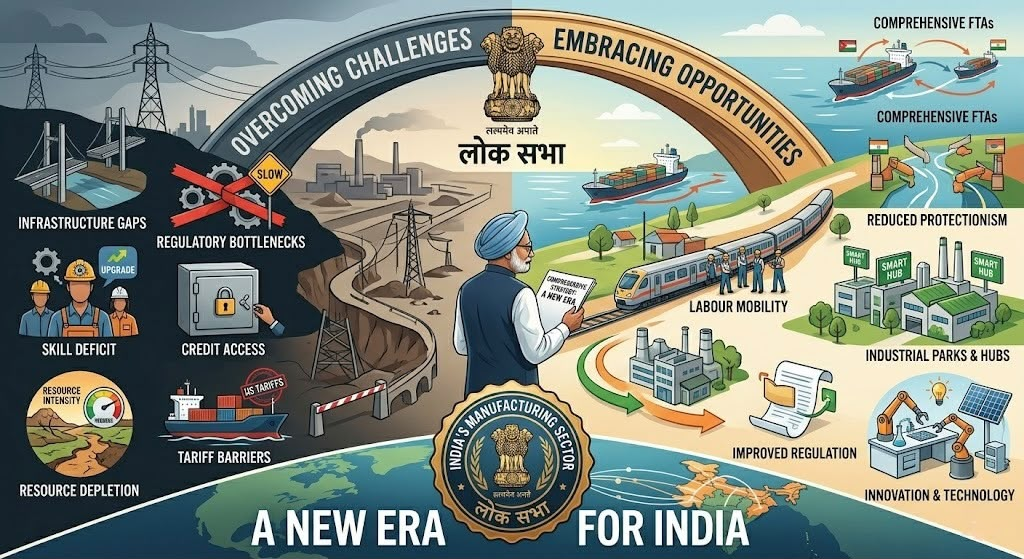 In spite of implementing the above initiatives, India still faces the following challenges which hinder its growth in Manufacturing Sector:
1. Lack of Infrastructure
2. Regulatory bottlenecks and red-tapism
3. Lack of Skill
4. Access to easy credit
5. Environmental Cost is very high as the Manufacturing Sector is Resource intensive using up a chunk of natural resources.
6.Tariff Barriers from US- Unstable policies of the US have negatively impacted the Manufacturing Sector.
India must be able to evolve a comprehensive strategy to enhance its manufacturing sector to be able to compete with the other manufacturing giants in the world. By embracing comprehensive Free trade agreements with major partners, reducing its protectionist policies, enhancing and encouraging internal labor mobility, investing in infrastructure like industrial parks and business hubs, evolving improved regulatory frameworks, and prioritizing technological as well as industrial innovation, India can compete from a position of strength in the global marketplace and take advantage of emerging opportunities.
References: -
https://www.pib.gov.in/PressReleasePage.aspx?PRID=2168711®=3&lang=2
https://www.thehindu.com/business/Economy/why-manufacturing-has-lagged-in-india/article70433540.ece