
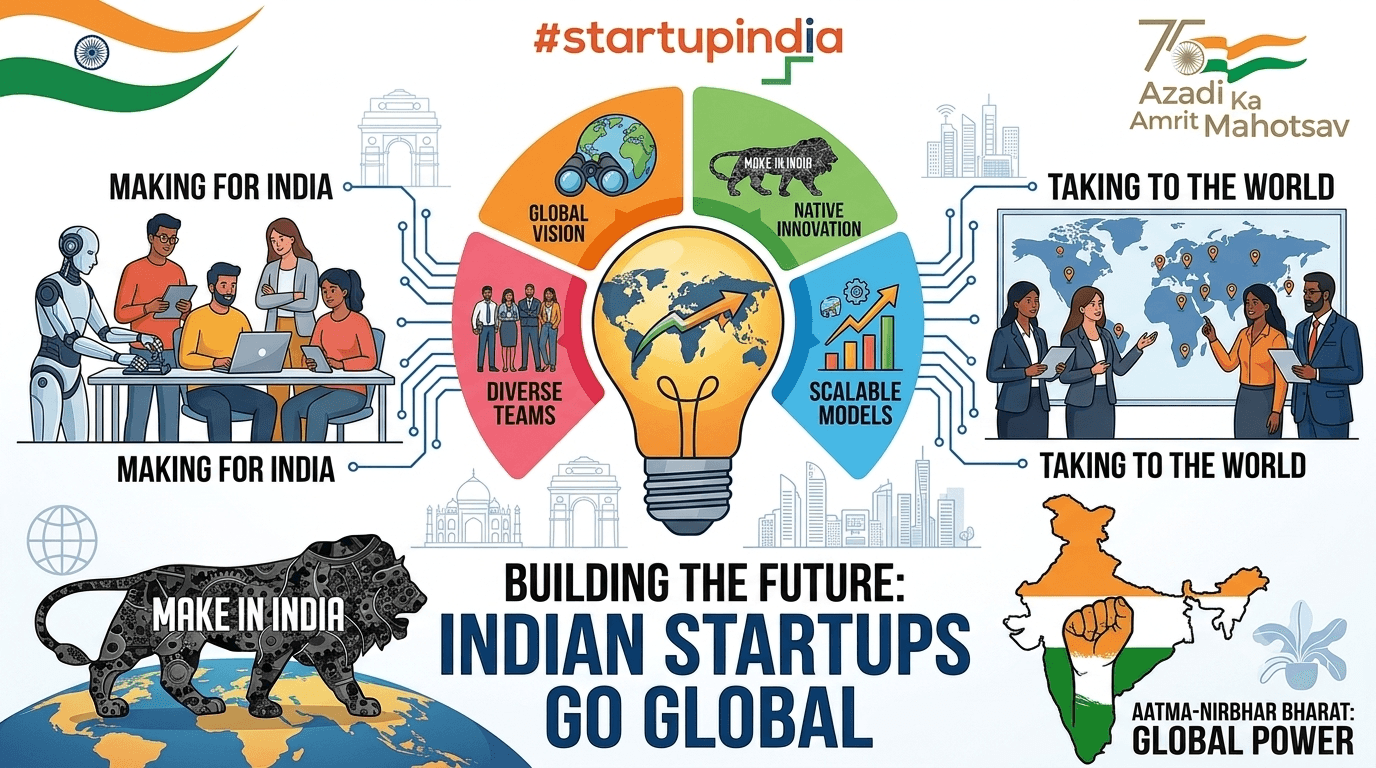
India's Startup Revolution -And Why Now Is the Best Time to Begin
India has quietly become one of the most exciting places on the planet to build a business. With over 1.4 billion people, a growing middle class hungry for products and services, a digital infrastructure that rivals the best in the world, and a government that has dramatically simplified the process of starting a company, the barriers to entrepreneurship have never been lower.
Whether you are a first-generation entrepreneur from a small town, a corporate professional ready to leap into independence, or an NRI looking to bring your venture back home, the path to launching your own business in India is more accessible, more affordable, and more legally straightforward than it was even five years ago.
But knowing where to start still trips up a surprising number of aspiring founders. Business registration, GST, MSME classification, Udyam certification - these terms get thrown around constantly, yet the practical steps involved often remain unclear. This guide cuts through the noise and walks you through everything: what you need to register, how much it will cost, how long it takes, and what compliance looks like once you are up and running.
Step 1: Choose the Right Business Structure
The single most consequential decision you will make before you register anything is choosing your business structure. This decision shapes everything from how much tax you pay, to how much personal liability you carry, to how easy it is to raise money down the road.
The Four Main Options
1. Sole Proprietorship
This is the simplest form - it is just you. There is no formal registration required (though you may need licenses depending on your sector). You keep all profits, but you also bear all liability personally. Ideal for freelancers, consultants, and small traders who want to test an idea without overhead.
2. Partnership Firm
Two or more individuals sharing ownership, profits, and liability. You can have a registered or unregistered partnership, though a registered one offers stronger legal protection. A Partnership Deed is the key document here. This works well for professionals like lawyers, chartered accountants, and architects who operate together.
3. Limited Liability Partnership (LLP)
The LLP is a hybrid - it gives you the flexibility of a partnership with the liability protection of a company. Each partner's personal assets are shielded from business debts. LLPs have lower compliance requirements compared to private limited companies and are particularly popular among service businesses and professional firms.
4. Private Limited Company (Pvt. Ltd.)
This is the gold standard for startups with growth ambitions. A private limited company is a separate legal entity, which means you are not personally liable for its debts beyond your shareholding. It is easier to raise investment, attract employees through ESOPs, and scale operations. It comes with more compliance requirements, but the benefits usually outweigh the costs once you are beyond the ideation stage.
Step 2: Obtain Digital Signature Certificate (DSC) and Director Identification Number (DIN)
Before you can register a company or LLP online, every proposed director must have two things: a Digital Signature Certificate (DSC) and a Director Identification Number (DIN).
Digital Signature Certificate (DSC)
India's Ministry of Corporate Affairs (MCA) portal requires all filings to be digitally signed. A DSC is a USB token or software certificate that acts as your legally valid electronic signature. You can obtain one from government-certified agencies such as eMudhra, Sify, or NSDL.
• Class 3 DSC is required for MCA and ROC filings
• Cost: approximately ₹1,000 to ₹2,000 per DSC
• Validity: 2 years, renewable
• Processing time: 1 to 3 business days
Director Identification Number (DIN)
A DIN is a unique 8-digit number assigned to each director of a company. Since 2018, the DIN application process has been integrated into the company incorporation form (SPICe+), so you no longer need to apply separately in most cases. However, existing directors already holding a DIN can use it directly.
Step 3: Company Incorporation via the MCA SPICe+ Form
The MCA's SPICe+ (Simplified Proforma for Incorporating Company Electronically Plus) is now the single integrated form for company registration. It consolidates what used to be multiple separate applications into one streamlined process.
What SPICe+ Covers in a Single Application
• Reservation of company name
• Director Identification Number (DIN) allocation
• PAN and TAN allotment
• EPFO and ESIC registration
• Opening a bank account (via AGILE-PRO-S, a linked form)
• GST registration (optional, can be included)
• Professional Tax registration (for certain states)
Documents Required
• PAN card and Aadhaar card of all directors and shareholders
• Passport (for foreign nationals or NRIs)
• Address proof of registered office (utility bill not older than 2 months)
• Rent agreement or NOC from property owner, if rented
• Passport-size photographs of all directors
• Memorandum of Association (MoA) and Articles of Association (AoA)
The Process, Step by Step
1. Log in to the MCA portal at mca.gov.in
2. File RUN (Reserve Unique Name) to get your company name approved -this costs ₹1,000 and must be done separately
3. Fill out SPICe+ Part A (name and entity type) and Part B (director and subscriber details)
4. Upload digitally signed MoA and AoA
5. Pay the registration fee, which scales based on authorized capital
6. Submit the AGILE-PRO-S form for GST, EPFO, ESIC, and bank account
7. Receive Certificate of Incorporation (CoI) from the Registrar of Companies (ROC)
The entire process, when documents are in order, typically takes 7 to 15 working days. The Certificate of Incorporation includes your Corporate Identification Number (CIN), PAN, and TAN - all in one document.
Step 4: GST Registration - When It Is Mandatory and How to Apply
The Goods and Services Tax (GST) unified India's complex indirect tax system in 2017. It replaced over a dozen central and state taxes with a single, destination-based tax. For most businesses, GST registration is either mandatory or highly advisable.
When Is GST Registration Mandatory?
• Your aggregate annual turnover exceeds ₹40 lakh (for goods) or ₹20 lakh (for services) in most states
• Your threshold is ₹10 lakh in special category states like Manipur, Mizoram, Nagaland, and Tripura
• You sell goods or services across state borders (inter-state supply), regardless of turnover
• You operate an e-commerce platform or sell through one
• You are a casual taxable person or non-resident taxable person
• You provide OIDAR (Online Information and Database Access or Retrieval) services
Benefits of Voluntary GST Registration (Even Below Threshold)
Even if your turnover is below the threshold, registering for GST voluntarily can be strategically smart. It allows you to issue GST-compliant invoices (mandatory for B2B sales to registered businesses), claim Input Tax Credit on your purchases, and build credibility with larger corporate clients who prefer registered vendors.
How to Register for GST
8. Visit the GST portal at gst.gov.in
9. Generate a Temporary Reference Number (TRN) using your PAN, email, and mobile number
10. Log in with TRN and fill out Form GST REG-01
11. Upload supporting documents: PAN, Aadhaar, business registration certificate, address proof, bank account details, photographs of promoters
12. An ARN (Application Reference Number) is generated upon submission
13. A GST officer reviews your application you may receive queries via Form GST REG-03
14. Upon approval, you receive a GSTIN (15-digit Goods and Services Tax Identification Number) and a registration certificate
GST Rate Structure at a Glance
India follows a multi-tier GST rate structure: 0% (essential goods like cereals and milk), 5% (everyday goods and some services), 12% (processed food, business-class air travel), 18% (most services and electronics), and 28% (luxury goods and sin taxes like tobacco and high-end cars). The rate applicable to your product or service depends on its HSN (Harmonised System of Nomenclature) or SAC (Services Accounting Code).
Step 5: MSME Classification and Udyam Registration
If your business qualifies as a Micro, Small, or Medium Enterprise — and a vast majority of Indian businesses do — registering under the MSME framework is one of the most valuable steps you can take. The benefits are real, wide-ranging, and often significantly reduce your cost of doing business.
How Are MSMEs Classified? (Post-2020 Revised Criteria)
Registration / Service | Govt. Fee | Professional Fee* |
Micro Enterprise | Investment ≤ ₹1 crore | Turnover ≤ ₹5 crore |
Small Enterprise | Investment ≤ ₹10 crore | Turnover ≤ ₹50 crore |
Medium Enterprise | Investment ≤ ₹50 crore | Turnover ≤ ₹250 crore |
The 2020 revision was a major milestone and it removed the distinction between manufacturing and service businesses, unified the criteria, and significantly raised the thresholds, allowing many businesses that previously fell outside the MSME bracket to now qualify.
What Is Udyam Registration?
Udyam Registration (udyamregistration.gov.in) replaced the older Udyog Aadhaar system in July 2020. It is entirely online, free of cost, and based on self-declaration. No documents need to be uploaded in the portal pulls data directly from PAN and GSTIN databases.
Benefits of Udyam Registration
• Priority lending at lower interest rates under Priority Sector Lending (PSL) norms
• Collateral-free loans under the Credit Guarantee Fund Scheme (CGTMSE)
• Protection against delayed payments from buyers under the MSME Development Act (buyers must pay within 45 days or pay compound interest)
• 50% discount on patent and trademark filing fees
• Electricity tariff concessions in many states
• Access to government e-Marketplace (GeM) portal for public procurement
• Preference in government tenders (public procurement policy mandates 25% of purchases from MSMEs)
• Reimbursement of ISO certification fees
How to Register on Udyam - Step by Step
15. Go to udyamregistration.gov.in
16. Click 'For New Entrepreneurs who are not Registered yet as MSME or those with EM-II'
17. Enter your Aadhaar number and business owner's name, then validate with OTP
18. PAN verification is done automatically for the business and individual
19. Fill in details: business name, type (proprietorship/LLP/company etc.), commencement date, bank account details, major activity (manufacturing or services), NIC code for your industry
20. Submit and receive your Udyam Registration Number (URN) and certificate instantly
The Udyam certificate is generated immediately in most cases. It is permanent that there is no renewal requirement as long as you continue to meet the MSME criteria. If your business grows beyond the thresholds, you can update your classification on the portal.
Step 6: Other Essential Registrations and Licenses
Depending on your business sector, location, and scale, you may need one or more additional registrations. Here is a practical overview of the most common ones.
Shops and Establishment Act Registration
Required for almost every business that operates a physical premises from retail shops to offices to restaurants. Each state has its own Shops and Establishments Act, and you must register with the local municipal authority or labour department within 30 days of commencing operations. The fee is minimal (typically a few hundred rupees), and the certificate must be displayed at your premises.
Import Export Code (IEC)
If you plan to import or export goods or services, you need an IEC issued by the Directorate General of Foreign Trade (DGFT). Applications are made online at dgft.gov.in. The process is quick and the fee is ₹500. An IEC is a 10-digit code linked to your PAN and is valid for life.
Trade License
Issued by local municipal corporations, trade licenses are required for businesses operating in specific categories including food businesses, hotels, factories, and chemists. The process, documentation, and fee vary by municipality and business type.
FSSAI Licence (Food Businesses)
If you are in any food-related business, manufacturing, processing, packaging, storage, distribution, or retail than you need a license from the Food Safety and Standards Authority of India (FSSAI). There are three tiers: basic registration (turnover under ₹12 lakh), state license (₹12 lakh to ₹20 crore), and central license (above ₹20 crore or multi-state operations).
Trademark Registration
While not mandatory, trademarking your brand name or logo is a powerful protective measure. File online at ipindia.gov.in. Costs ₹4,500 per class for individuals and MSMEs (50% discount vs the standard ₹9,000 fee), and ₹9,000 per class for companies. Registration takes 18 to 24 months on average, but you get the TM symbol (™) immediately upon filing.
Complete Cost Breakdown: What Does It Actually Cost to Register a Business?
One of the most common questions from first-time entrepreneurs is about the real cost of getting everything in place. Here is a consolidated breakdown of typical government fees and professional charges.
Registration / Service | Govt. Fee | Professional Fee* |
Company Name Reservation (RUN) | ₹1,000 | - |
Private Limited Company Incorporation (SPICe+) | ₹5,000 - ₹20,000 (scales with capital) | ₹8,000 - ₹20,000 |
DSC (per director) | ₹1,000 - ₹2,000 | - |
GST Registration | Free | ₹1,500 - ₹5,000 (optional CA) |
Udyam / MSME Registration | Free | Free (DIY only) |
IEC (Import Export Code) | ₹500 | ₹1,000 - ₹2,000 |
Trademark Registration (per class) | ₹4,500 (MSME) | ₹3,000 - ₹8,000 |
FSSAI Basic Registration | ₹100/year | ₹2,000 - ₹5,000 |
Shops & Establishment Registration | ₹200 - ₹5,000 (state-dependent) | ₹1,000 - ₹3,000 |
*Professional fees vary significantly based on city, CA/CS experience, and complexity. These are estimates for standard, uncomplicated registrations.
Startup India: Additional Benefits for Eligible Startups
If your business qualifies as a 'startup' under the Department for Promotion of Industry and Internal Trade (DPIIT) definition, you gain access to a separate layer of incentives that go well beyond standard MSME benefits.
DPIIT Startup Recognition Criteria
• The entity must be incorporated as a Private Limited Company, LLP, or Registered Partnership Firm
• It must have been incorporated less than 10 years ago
• Annual turnover must not have exceeded ₹100 crore in any financial year since incorporation
• It must be working towards innovation, development, or improvement of products, processes, or services
• It should not be formed by splitting up or reconstructing an existing business
Key Benefits Under Startup India
• Tax holiday: 3 years of income tax exemption (out of the first 10 years since incorporation), subject to approval from Inter-Ministerial Board
• Exemption from tax on long-term capital gains if reinvested in eligible startups (Section 54GB)
• Self-certification compliance for 9 labour laws and 3 environmental laws for 5 years
• 80% reduction in patent filing fees, with faster examination through the Patent Facilitation Centre
• Access to ₹10,000 crore Fund of Funds managed by SIDBI, which invests in SEBI-registered AIFs (Alternate Investment Funds) that in turn invest in startups
• Easy wind-up provisions - startups can be closed down within 90 days under the Insolvency and Bankruptcy Code
How to Apply for DPIIT Recognition
21. Visit startupindia.gov.in
22. Register and create a profile
23. Fill in details about your business, team, and innovation
24. Upload your incorporation certificate
25. Submit your recognition is typically granted within 2 working days if criteria are met
Common Mistakes First-Time Entrepreneurs Make And How to Avoid Them
Knowing what not to do is just as important as knowing what to do. These are the most frequent and costly errors that new business owners in India make during the registration and early compliance phase.
1. Choosing the Wrong Business Structure
Many founders default to a sole proprietorship because it is easy, then later discover that a corporate client will not pay them without a GST invoice, or an investor refuses to engage because there is no equity structure to invest in. Think ahead. If you have any growth ambitions, start as a Pvt. Ltd. or at least an LLP.
2. Ignoring Compliance After Registration
Registering a company is the beginning, not the end. A private limited company must hold Annual General Meetings (AGMs), file annual returns with the ROC (Form MGT-7 and AOC-4), maintain statutory registers, and comply with income tax and GST filings. Ignoring these leads to penalties, disqualification of directors, and in severe cases, company strike-off.
3. Not Protecting the Brand Early
Founders routinely delay trademark registration, assuming it is something to handle 'later'. By the time they are ready, someone else has filed the same name. File your trademark as early as possible it costs under ₹5,000 for MSMEs and gives you the right to the TM symbol immediately.
4. Operating Without GST When Crossing the Threshold
Many small businesses are unaware of when their turnover crosses the GST threshold. Operating without registration after crossing ₹20 lakh (services) or ₹40 lakh (goods) exposes you to back taxes, interest (18% per annum), and penalties of up to 100% of the tax evaded.
5. Using Personal Bank Accounts for Business Transactions
This is far more common than it should be. Mixing personal and business finances makes accounting a nightmare, creates tax complications, and undermines the legal protection that a Pvt. Ltd. or LLP structure provides. Open a dedicated current account for your business from day one.
Final Thoughts: Your Roadmap to a Legally Compliant Indian Business
Starting a business in India in 2024 is genuinely achievable without deep bureaucratic experience or expensive consultants. The government has done the hard work of digitizing and streamlining most processes. The challenge is knowing where to look and in what order to proceed.
Here is your action sequence, summarized:
26. Decide your business structure Sole Proprietorship, Partnership, LLP, or Private Limited Company
27. Get your DSC and, for companies, proceed with SPICe+ on the MCA portal for incorporation
28. Apply for GST registration if your turnover exceeds the threshold, or voluntarily if you sell B2B
29. Register on the Udyam portal if you qualify as an MSME it is free and unlocks significant benefits
30. Apply for sector-specific licenses like FSSAI, trade license, or IEC as relevant
31. Apply for DPIIT Startup India recognition if your venture qualifies
32. Protect your brand with a trademark filing
33. Set up a current bank account and an accounting system from day one
Each step builds on the last. The businesses that get into legal and financial trouble are rarely the ones that chose a bad idea. They are usually the ones that cut corners at the foundation. Do it right from the start, and you will spend far more of your time building the business and far less managing avoidable problems.
India is open for business. The question is: are you ready to begin?